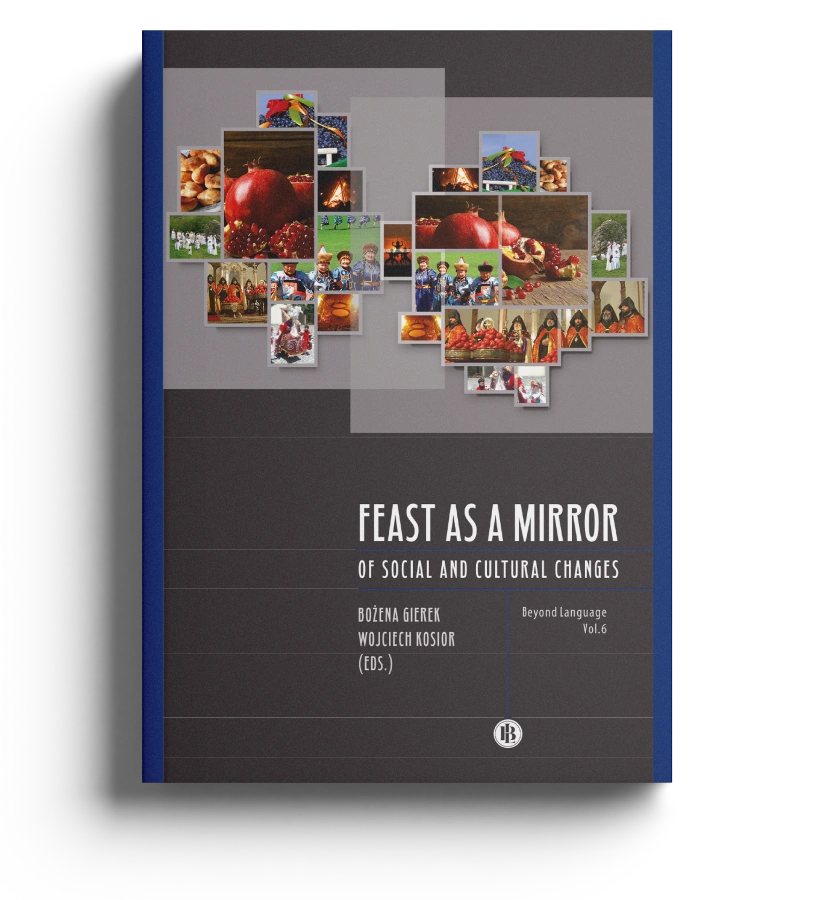
Feast as a Mirror of Social and Cultural Changes
Description
Feasting seems to be an inseparable element of peoples’ lives, especially in their collective form. The proposed volume consists of original unpublished texts in which their authors search for the answers to the following questions:
– How far have we gone astray from the primeval idea of celebrating the feast, from understanding tradition in terms of the Romanian historian of religion, Mircea Eliade, or the French sociologist, Émile Durkheim?
– Are there still any traditional, in its very meaning, feasts?
– If not—if they are invented—why are they called “traditional”?
– What elements have changed and why?
– What has had the greatest impact on celebrating feasts?
– What are the new factors influencing the course of a feast’s celebration?
The contributors represent various international institutions and fields of research, and thus use different approaches and methodologies to study the subject of the feast. This publication is an opportunity to bring the results of their research together in one book with chapters on various aspects of feasts, festivals, and festivities perceived as a mirror of social and cultural changes in the twentieth and twenty-first centuries. It provides a unique and rich resource in the fields of culture, folklore, religion, anthropology, sociology, as well as politics and other cultural and social sciences.
The phenomenon of the FEAST […] provides exceptionally precious material for researching social and cultural changes, including the influence of urbanization on rural feasts. Therefore, it can be perceived as a mirror that reflects those changes. French historian Jacques Heers calls it “a mirror of civilization,” because it is always placed in the social context in which it “springs up and determines its vital shapes and colors” […]. The feast allows us to look, at the same time, at traditional and new elements of a particular culture that coexist next to each other or with each other. The changes in the feasts are “sensitive indexes” of the changes of values, ideas and ideologies, social and political structures, their functioning, and cultural creativity. […]
The proposed volume meets the growing interest in intercultural comparison of social changes, especially in festivities. It enriches the empirical basis of accounts on festivities in general because it contains detailed case studies—mostly based on the authors’ own field research—from European, Asian, and African countries. […]—Bożena Gierek, from the “Introduction”
Technical information
Author
Bożena Gierek, Wojciech Kosior
Published in
2020
Series
Beyond Language
Volume
6
Editor
Piotr P. Chruszczewski, Aleksandra R. Knapik
Edition
1st ed.
ISBN
pbk: 978-1-68346-196-8, ePub: 978-1-68346-198-2, mobi: 978-1-68346-197-5, pdf: 978-1-68346-199-9, ISSN: 2642-6951 (print), 2642-696X (online)
# of pages
x + 211
Binding
pbk, sewn
Dimensions
148 x 210 mm
Weight
300 g